
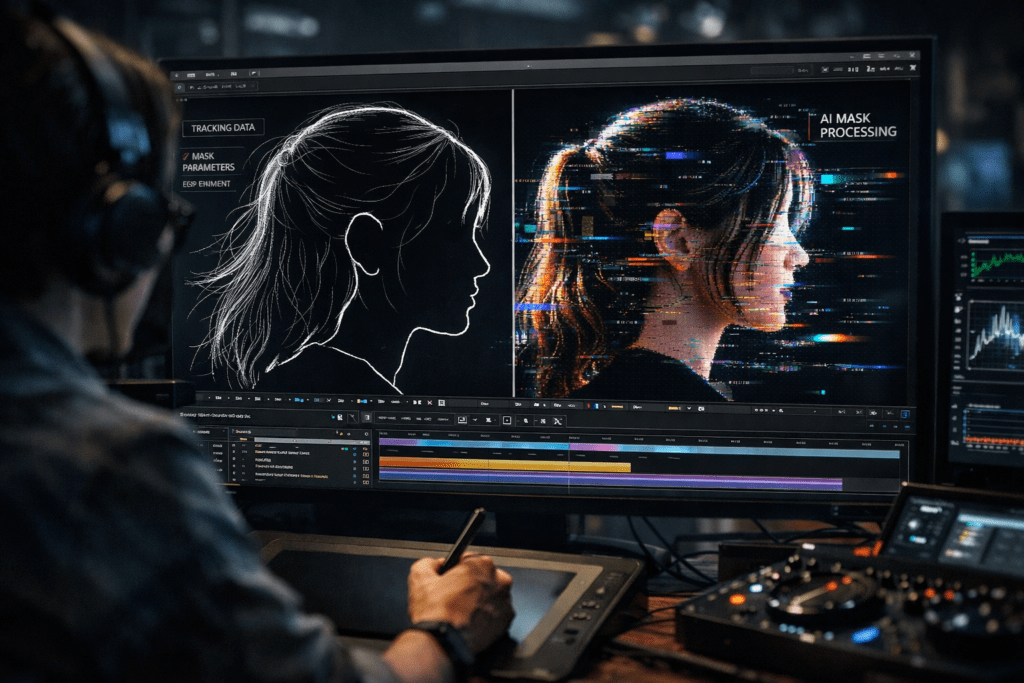
Introduction to Rotoscoping and Automation
Rotoscoping is one of the oldest yet most critical techniques in visual effects. Despite massive advancements in artificial intelligence, the question remains: why rotoscoping still can’t be automated properly?
At first glance, automation seems inevitable. After all, AI can generate images, write code, and even edit videos. But rotoscoping is a different beast altogether. It requires precision, consistency, and creative judgment—qualities machines still struggle to replicate fully.
What Is Rotoscoping in Modern VFX?
Rotoscoping is the process of isolating objects or characters frame-by-frame in a video. Artists draw masks around subjects so they can be placed into new environments or edited independently.
Modern tools have digitized the process, replacing paper tracing with spline-based masks and tracking systems. However, the core idea remains unchanged: frame-by-frame accuracy.
Evolution from Manual to AI-Assisted Workflows
Initially, rotoscoping was entirely manual. Artists painstakingly traced each frame, which could take hours for just a few seconds of footage.
Today, AI-assisted tools help speed things up by:
- Tracking movement across frames
- Predicting object boundaries
- Automating initial mask creation
But these tools don’t eliminate the need for human input—they simply reduce the workload.
The Promise of AI in Rotoscoping
Machine Learning and Video Segmentation
AI models use deep learning to identify objects in images and videos. These models analyze patterns, textures, and motion to create masks automatically.
In theory, this should replace manual work. In reality, it only works well under ideal conditions.
Popular Tools Using AI Assistance
Modern software includes AI-powered features such as:
- Automatic subject selection
- Mask propagation across frames
- Background removal
These tools are helpful but far from perfect. They require manual corrections, especially in complex scenes.
Why Rotoscoping Still Can’t Be Automated Properly
Visual Complexity and Fine Detail Loss
One of the biggest reasons why rotoscoping still can’t be automated properly is the sheer complexity of real-world visuals.
AI struggles to interpret:
- Thin edges
- Fine textures
- Subtle transitions
Hair, Fur, and Motion Blur Challenges
Hair strands and fur are extremely difficult to isolate because they:
- Are often only a few pixels wide
- Blend into the background
- Move unpredictably
Motion blur makes things worse by smearing edges, confusing AI models.
Occlusion and Object Interference
Occlusion occurs when one object blocks another. This is a nightmare for automation.
Why AI Struggles with Hidden Objects
AI cannot “remember” parts of an object once they disappear behind something else. When the object reappears, the model often:
- Misidentifies it
- Loses track entirely
- Creates inconsistent masks
This leads to flickering and errors that require manual fixes.
Lighting and Environmental Variability
Lighting changes can dramatically alter how objects appear in a scene.
Shadows, Reflections, and Transparency
AI struggles with:
- Shadows that look like objects
- Reflections in mirrors or glass
- Transparent elements like smoke or water
These effects break the assumption that objects have clear, solid boundaries.
Motion and Frame Inconsistency
Fast movement introduces another layer of complexity.
Temporal Flickering Problems
Even if AI gets one frame right, it may fail in the next. This creates:
- Flickering edges
- Jittery masks
- Inconsistent outlines
Consistency over time is one of the hardest challenges in video processing.
Low-Quality Footage Limitations
AI models perform best on high-quality footage. But in real-world scenarios, videos often have:
- Compression artifacts
- Low resolution
- Noise and grain
These factors reduce accuracy and increase errors.
Human-in-the-Loop: Why Artists Are Still Essential
Manual Corrections and Refinements
Even with AI assistance, artists must:
- Review every frame
- Fix edge errors
- Add missing details
This process ensures professional-quality results.
Creative Control vs Automation
Rotoscoping isn’t just technical—it’s creative. Artists decide:
- What to include or exclude
- How soft or sharp edges should be
- How the final composite looks
AI lacks this level of judgment.
Real-World Workflow Breakdown
Step-by-Step Rotoscoping Process
- Create an initial mask
- Use AI to propagate it
- Review frame-by-frame
- Correct errors manually
- Refine edges and details
This loop repeats until the result is perfect.
Time and Cost Implications
Rotoscoping is expensive because it’s time-consuming. Even with AI:
- Complex shots take hours
- High-end projects demand perfection
- Small errors are unacceptable
Automation hasn’t eliminated these costs—it has only reduced them slightly.
AI Tools: Strengths vs Weaknesses
Where AI Performs Well
AI works best in:
- Static shots
- Clear backgrounds
- Simple shapes
- Minimal motion
In these cases, it can save significant time.
Where AI Fails Consistently
AI struggles with:
- Complex motion
- Fine details
- Occlusions
- Lighting changes
These are exactly the scenarios most common in professional filmmaking.
Future of Rotoscoping Automation
Emerging Technologies and Research
New developments include:
- Video matting networks
- Improved segmentation models
- Better temporal consistency algorithms
These innovations are promising but not yet perfect.
Will Full Automation Ever Be Possible?
It’s possible—but not anytime soon.
For full automation to work, AI must:
- Understand context like humans
- Handle ambiguity flawlessly
- Maintain consistency across frames
We’re not there yet.
FAQs
1. Why is rotoscoping so difficult to automate?
Because it involves complex visual scenarios like motion blur, occlusion, and fine details that AI struggles to interpret accurately.
2. Can AI completely replace rotoscoping artists?
No, AI can assist but cannot fully replace human expertise and judgment.
3. What are the biggest challenges for AI in rotoscoping?
Hair, motion blur, lighting changes, and object occlusion are the biggest obstacles.
4. Are there fully automated rotoscoping tools available?
There are automated tools, but none can deliver professional-quality results without manual correction.
5. How much time does rotoscoping take?
It depends on complexity, but even short clips can take hours to complete.
6. Will rotoscoping become fully automated in the future?
Possibly, but it will require major breakthroughs in AI and computer vision.
Conclusion
So, why rotoscoping still can’t be automated properly comes down to one simple truth: the real world is messy, unpredictable, and full of edge cases that AI can’t fully understand yet.
While automation has improved efficiency, it hasn’t replaced the need for skilled artists. Rotoscoping remains a craft that blends technical precision with human creativity.
For now, the future of rotoscoping isn’t full automation—it’s smarter collaboration between humans and machines.